Popcorn Ceiling Removal San Diego logo San Diego
Ceiling Repair
☎ (619) 825-1802
★★★★★ 100% Satisfaction Guaranteed

San Diego Ceiling Repair.

We repair drywall ceilings, plaster ceilings and bathroom ceilings across San Diego, texture matched so the fix disappears. Workmanship guaranteed, zero mess left behind.

  • Free Fast Estimates
  • We Fix Water Stains, Cracks, Sagging, Holes
  • Ceiling Repair Contractors for 15+ Years
Why Call Us First

Why San Diego Homeowners Trust Us for Ceiling Repair

1

Ceiling Repair Is Our Specialty

Ceilings are tricky: compound sags as it dries, patches can droop before they cure, and natural light exposes every flaw a wall would hide. It's why so many drywall contractors avoid overhead work. We're the opposite. We do a lot of popcorn ceiling removal, so our crew has spent 15+ years patching, taping, and texturing ceilings week in, week out. When your problem is above your head, that's exactly the experience you're hiring.

2

Texture Matching That Makes the Repair Disappear

A ceiling patch is the easiest in the house to spot, because light rakes across ceilings all day and every flaw casts a shadow. That's why texture matching is included in every ceiling repair we quote. Knockdown, orange peel, popcorn, smooth, or hand texture: we always test the match first, feather it wide, and check it under harsh angled light before we call it finished. We also back all ceiling repair jobs with our 2-year workmanship guarantee.

3

Licensed & Insured Ceiling Contractor: Firm Quotes, Zero Mess

Everything on a ceiling job falls straight down, so we cover floors, wrap furniture, and hang plastic before a single cut. You get a firm written price, not an hourly meter, and a written workmanship warranty. And if your ceiling problem is actually a roof or plumbing problem first, we'll tell you that for free instead of selling you a repair that won't hold.

What We Do

Ceiling Repair Services in San Diego

Drywall, plaster, popcorn, knockdown, smooth, flat or vaulted. If it's over your head and it's damaged, this is the work we do all day.

Water Damaged Ceiling Repair

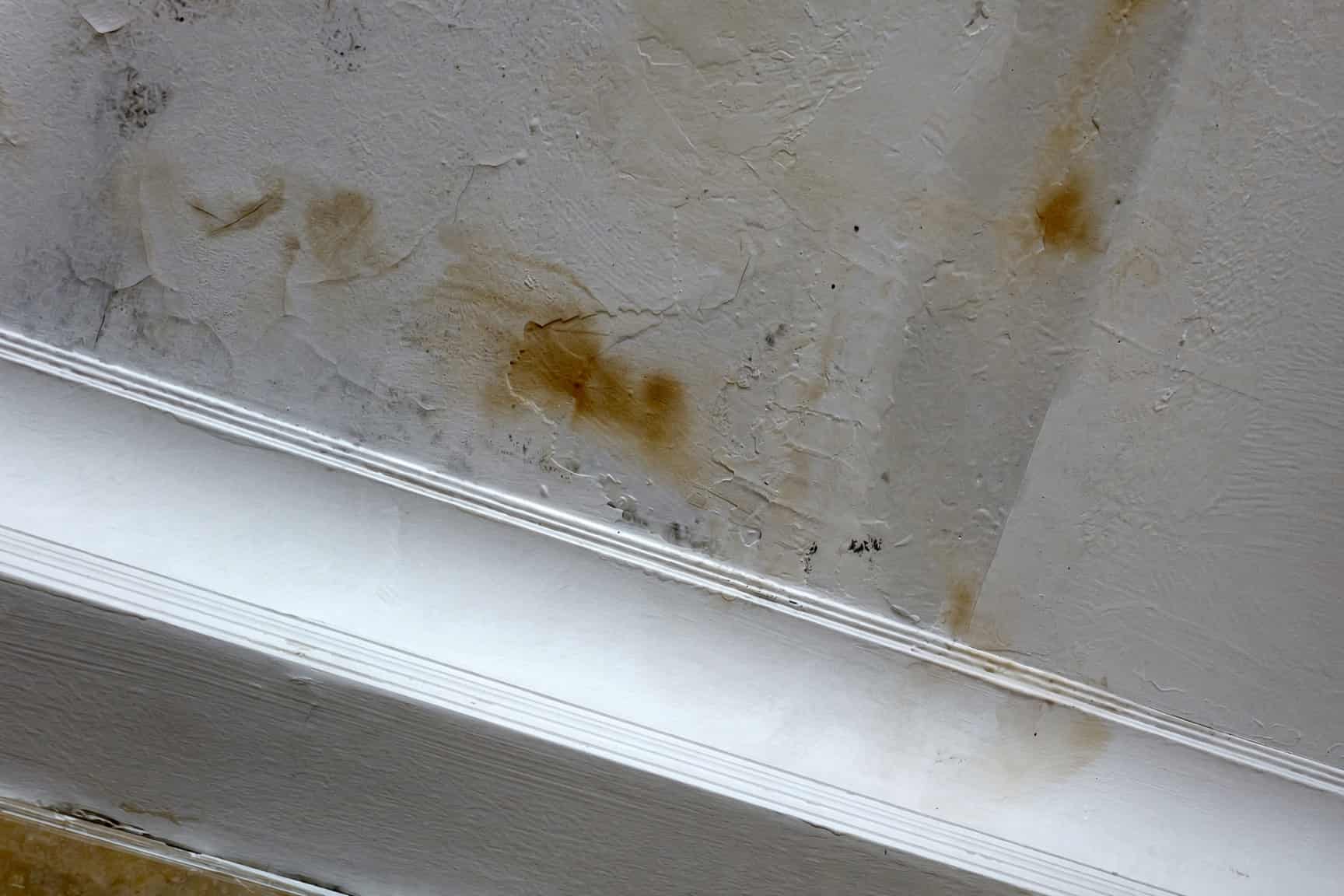
Brown water stain on a bedroom ceiling in a San Diego home before repair

The brown ring on the ceiling is the most common call we get, and it usually traces back to an upstairs bathroom, a water heater, a roof that leaked in the last storm, or in condos, the neighbor's unit. Once the leak itself is fixed, we handle everything you can see: stains sealed so they never bleed through paint, soft or sagging board cut out and replaced, insulation checked from the attic side, and texture matched so the ceiling looks like the leak never happened.

If the drywall is still firm, the fix might be as simple as sealing and refinishing. If it soaked, we replace the section. We check with a moisture meter instead of guessing, because sealing a damp ceiling just traps the problem.

  • Ceiling leak damage repaired after plumbing, roof, and appliance leaks
  • Water stains sealed with stain-blocking primer, then retextured and painted
  • Soft, sagging, or collapsed sections cut out and replaced
  • Moisture verified with a meter before anything gets closed up

Bathroom Ceiling Repair

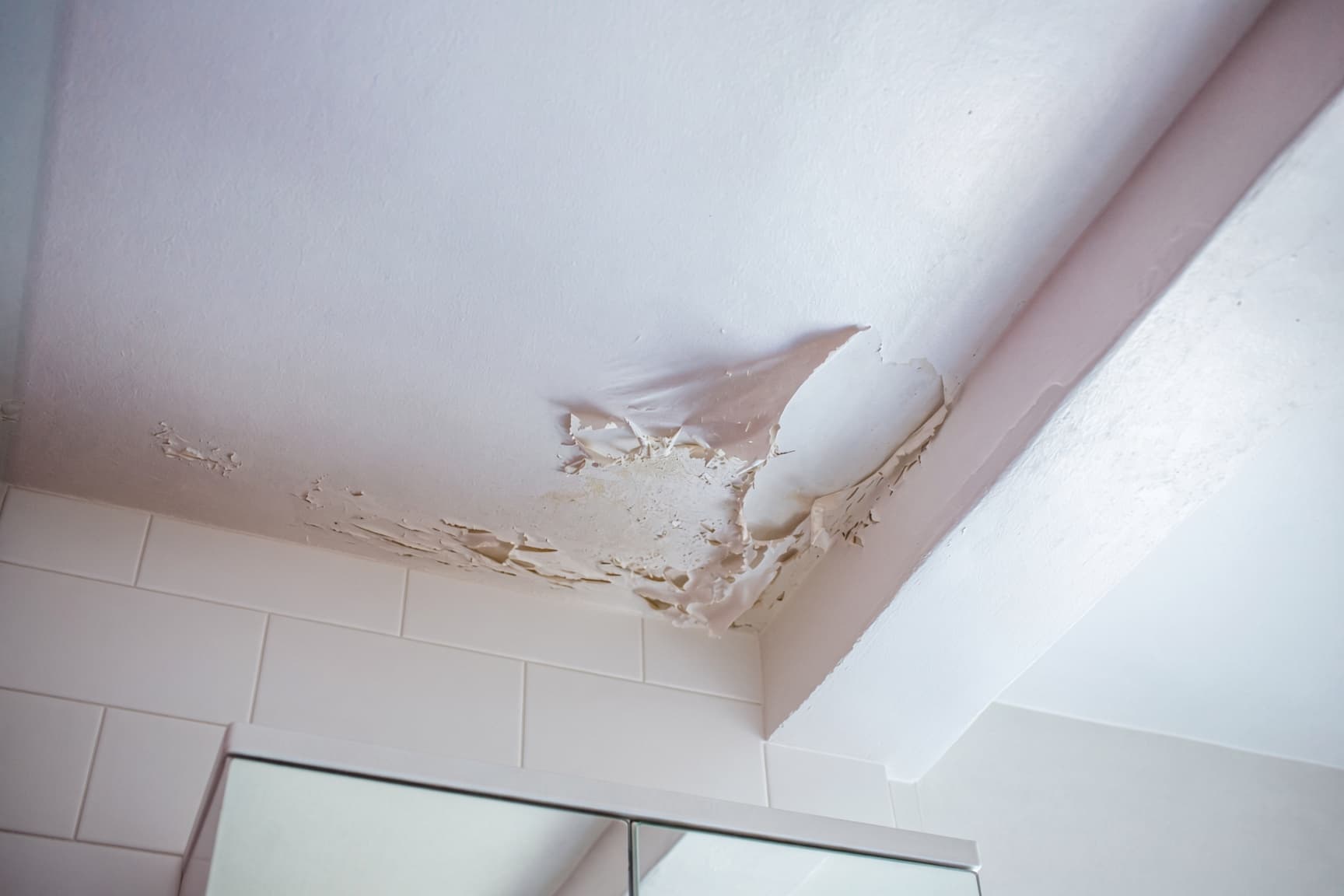
Peeling paint on a bathroom ceiling in San Diego before repair

Bathroom ceilings tend to fail in the form of peeling and bubbling paint from daily steam, gray mold spots in the corners, stains from the shower drain upstairs, and soft board around the exhaust fan. Coastal homes in Pacific Beach, Ocean Beach, and Point Loma bear the brunt of this, since marine air keeps bathrooms from ever fully drying out.

But no worries, we can scrape back everything that's failing, treat and seal properly, replace board that's gone soft, and refinish with materials that stand up to humidity. And we check the fan itself, because a surprising number of older San Diego bathroom fans are undersized or vent into the attic instead of outside, which quietly feeds the attic side of your ceiling moisture every shower. If the fan is the real culprit, we'll say so, because otherwise you're repainting the same ceiling in two years.

  • Peeling, flaking, and bubbling bathroom ceiling paint fixed properly
  • Surface mold spots treated and sealed, with honest advice when it's beyond surface level
  • Moisture-resistant materials used where steam lives
  • Ceilings repaired around exhaust fans, lights, and shower enclosures

Ceiling Crack Repair

Long crack running along a drywall ceiling seam in a San Diego home

Most ceiling cracks follow the seams between drywall sheets, which is why they run in suspiciously straight lines. The tape under the surface lets go as the house settles and the framing moves through San Diego's dry summers and damp winters, and hillside and canyon lots in La Mesa, Del Cerro, and Mt. Helix see it constantly. Smearing filler in the crack is only a six-month fix before you have to do it again. Cutting back and re-taping the seam is the one that lasts.

We also repair spiderweb cracking in texture, cracks radiating from can lights and fans, and the wall-to-ceiling corner cracks that open up seasonally. And if a crack looks like more than settling, we'll tell you before we patch anything.

  • Seam cracks cut back and re-taped so they don't return
  • Hairline and spiderweb texture cracking refinished
  • Cracks at corners, can lights, and ceiling fans repaired at the cause
  • We'll tell you which cracks are cosmetic and which deserve a structural look
Sagging Ceiling Repair

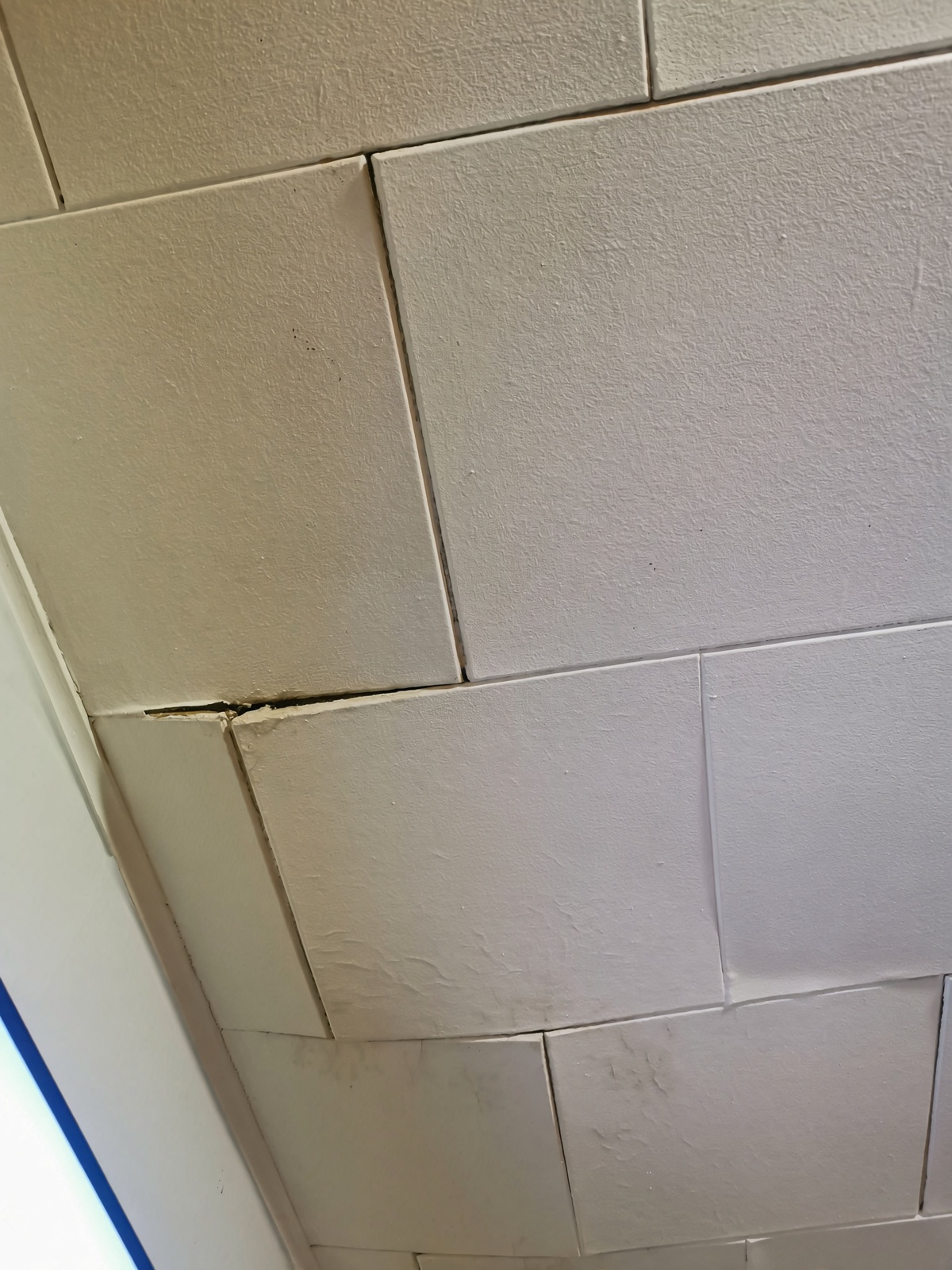
Sagging drywall ceiling section in a San Diego room before re-fastening

A ceiling that's drooping, pillowing between joists, or pulling away at a seam is telling you the board is losing its grip, and it's the one ceiling problem we ask people not to sit under while they think it over. In drywall, sagging usually means moisture got into the board or the original fasteners are failing. If your ceiling is plaster, it means the keys holding the plaster to the lath have broken.

Where the board is dry and sound, we re-fasten it flat with screws into the joists. Where it's wet or crumbling, the sagging section comes down and new board goes up. Plaster gets its own approach, reattached with plaster washers or adhesive rather than yanked flat.

  • Sagging drywall re-secured with screws, or replaced when it's too far gone
  • Garage ceiling sag from failed nails and old insulation weight fixed
  • Sagging plaster reattached to lath, preserving the original ceiling
  • Honest tradeoffs of repair vs. replacement, quoted both ways when it's close

Ceiling Hole Repair & Patching

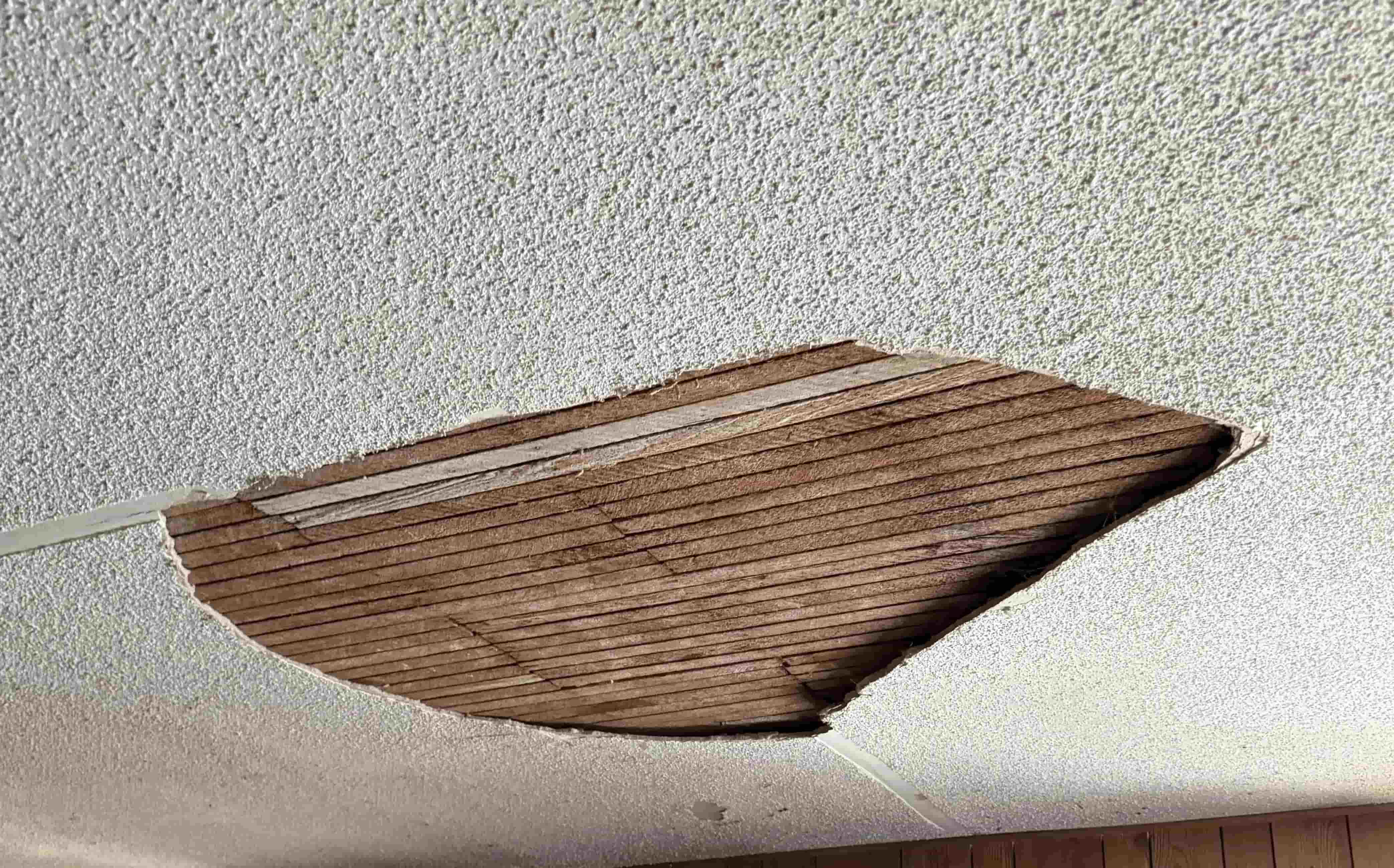
Hole in a ceiling ready to be patched in a San Diego home

Ceiling holes arrive in every size: the access cut your plumber left behind, the opening where an old light or fan came out, moving-day furniture damage, and maybe a leftover crater from a previous repair that never got finished. Closing them up correctly means solid backing, real taping, wide feathering, and a texture match, so the ceiling doesn't carry a permanent rectangle.

We patch access cuts behind plumbers, electricians, HVAC techs, and solar installers every week, and we can schedule right behind your other contractor so the room is whole again quickly.

  • Access holes patched after plumbing, electrical, HVAC, and solar work
  • Holes from removed fixtures, fans, and speakers closed and blended
  • Attic misstep and impact damage repaired with proper backing
  • Bad previous patches cut out and redone so they finally disappear

Drywall Ceiling Repair & Replacement

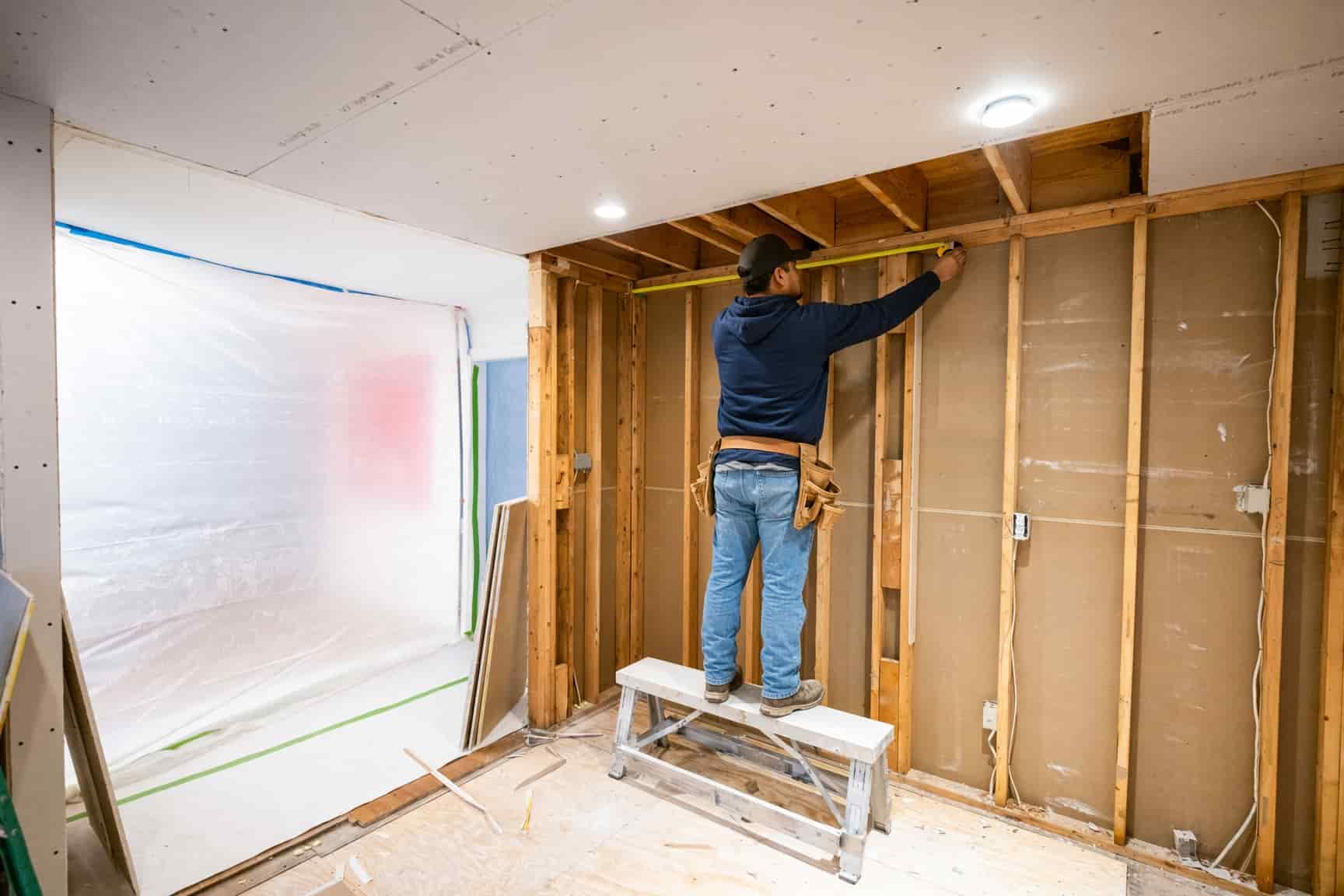
New drywall ceiling being installed in a San Diego home after tear-out

Sometimes a ceiling is past patching: a big section came down in a leak, decades of overlapping repairs left it lumpy, or a remodel calls for a fresh start. We tear out the old ceiling under full dust containment, haul the debris, then hang, tape, and finish new board to whatever finish you want, from standard knockdown to a Level 5 smooth ceiling that looks like glass.

Partial replacement is another option, and it's what most jobs actually need. We cut out only the damaged area, tie new board into the old, and blend the finish so you can't find the seam. It costs a fraction of a full ceiling and looks just as good when blended right.

  • Full ceiling tear-out and replacement with dust containment and disposal
  • Partial section replacement blended invisibly into the existing ceiling
  • Any ceiling finish you prefer: smooth, knockdown, orange peel, or matched to what you have
  • Vaulted, high, and two-story ceilings handled with proper equipment
Plaster Ceiling Repair

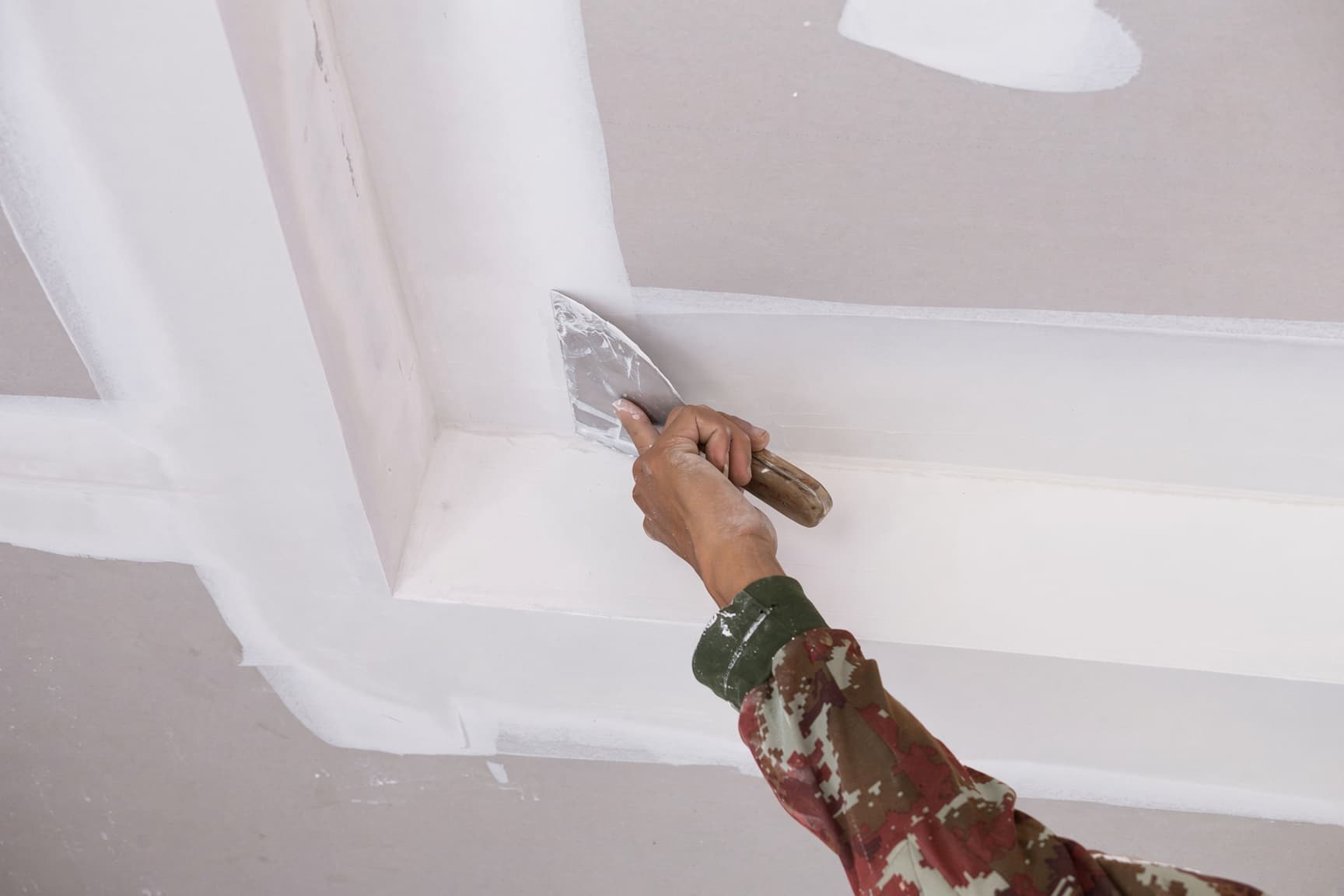
Original lath and plaster ceiling being repaired in a North Park San Diego craftsman home

If your home was built before about 1950, think North Park, South Park, Kensington, Golden Hill, Mission Hills, or the older blocks of La Mesa and Coronado, there's a good chance your ceilings are lath and plaster, not drywall. Plaster is a beautiful material but it repairs badly when treated like drywall, which is how a lot of cracked-out patches happen.

We repair plaster with a modified approach: loose sections stabilized and reattached to the lath, cracks bridged with the right compounds instead of rigid filler, holes patched in layers, and transitions blended.

  • Cracked, loose, and sagging plaster stabilized and repaired
  • Plaster reattachment with washers or adhesive, keeping the original ceiling
  • Plaster-to-drywall transitions from old remodels blended cleanly
  • Same careful approach we bring to older coastal cottages in Encinitas and Leucadia

Ceiling Texture Repair, Matching & Popcorn Patches

A structurally sound patch with the wrong texture is still a failed repair, because it sticks out in the home. We match ceiling textures with great care: popcorn texture dabbed and blended into the surrounding texture, knockdown sprayed and troweled to the same profile, orange peel dialed in by droplet size, and smooth ceilings feathered until there's nothing to see.

If you have popcorn texture and you're leaning toward getting rid of the popcorn entirely rather than patching it, we remove popcorn ceilings on the regular, and we can price both options in the same visit.

  • Popcorn ceiling patched and blended
  • Knockdown, orange peel, and hand textures matched to your ceiling
  • Whole-ceiling retexture when a spot match won't blend
  • Full popcorn ceiling removal quoted alongside the repair if you want to compare

Garage, Patio & Wood Ceiling Repair

Not every ceiling is interior drywall. We often see garage ceilings sagging from failed nails and roof leaks nobody noticed for months, covered patios and eaves wear heavy stucco and spray textures that interior-only crews won't touch, and the older beach cottages around Ocean Beach, Point Loma, and North Park have tongue-and-groove wood ceilings that salt air ages fast.

We match the coarser stucco and spray textures with the right technique, replace and refinish wood boards to blend with what's there, and on attached garages we put fire-rated Type X board back on any ceiling shared with living space, because that's what code requires and what the inspector checks.

  • Garage ceiling sag, leak damage, and impact repair
  • Stucco and heavy spray texture matched on patios, eaves, and garages
  • Tongue-and-groove wood ceiling board replacement and refinishing
  • Type X fire-rated board restored on garage ceilings shared with living space
What Your Ceiling Is Telling You

Common Ceiling Problems in San Diego Homes

Here's what we see most around San Diego, what causes it, and how urgent it tends to be.

A Brown Water Stain or Ring on the Ceiling

This means water reached the drywall at some point. If it's below an upstairs bathroom, the likely sources are the toilet seal, the shower pan, or a supply line. If on a top floor, it's the roof, and San Diego roofs tend to reveal their leaks all at once during the first real rain of the season. In condos, it's often the unit above.

Press the stain gently. Firm board usually just needs the leak confirmed fixed, then sealing, retexture, and paint. Soft board needs that section replaced. Either way, don't paint over it with ordinary paint because the stain will bleed back through within weeks.

A Straight Crack Running Across the Ceiling

Straight cracks follow the seams between drywall sheets, and they mean the tape under the surface has let go, usually from settling and seasonal framing movement. We see this very commonly on hillside lots in La Mesa, Del Cerro, and Spring Valley.

The lasting fix is re-taping the seam, not filling the crack. A few cracks deserve a closer look first: ones wide enough to fit a credit card into, ones that continue down a wall, or ones paired with sagging. If that sounds like yours, we'll take a closer look before doing any cosmetic work.

A Sagging, Pillowing, or Drooping Ceiling Section

A sagging ceiling means the material is losing its grip. In drywall, the board has usually soaked up moisture or the nails holding it to the framing are pulling loose. In older plaster, the plaster has broken away from the wood strips it grips behind the surface. Either way, the ceiling only sags further from here, and a water-soaked section is much heavier than it looks when it comes down.

This is the ceiling problem we treat as urgent every time. Keep people and pets out from under it and call us. If the ceiling is bulging with water, put a bucket underneath and poke a small hole at the lowest point of the bulge so the water drains out slowly. It feels wrong to make a hole in your own ceiling, but a controlled drip beats a collapse.

Peeling or Bubbling Paint on a Bathroom Ceiling

Daily steam with nowhere to go condenses on the ceiling, works under the paint, and lifts it. Bathrooms with weak or missing exhaust fans get it worst, and coastal homes especially struggle with this because the air never fully dries out.

Scraping and repainting is the quick fix, but it usually peels again within a year, because the moisture that lifted the paint is still hitting the ceiling every shower. A lasting repair treats both: we remove the failing layers, replace any board that's gone soft, then seal and refinish the surface with moisture-resistant materials. And if a weak exhaust fan is the real cause, we'll tell you, because no ceiling repair outlasts the problem that keeps causing it.

Dark Spots or Mold Specks on the Ceiling

Gray or black speckling in ceiling corners is usually surface mold feeding on condensation, most common in bathrooms, closets against exterior walls, and north-facing rooms. Small surface spots on firm board can typically be treated, sealed, and refinished.

Larger patches, fuzzy growth, or mold paired with soft drywall suggest moisture inside the assembly, and that's when we stop and tell you what we're seeing rather than paint over a problem. We don't seal trouble into a ceiling.

Popcorn Ceiling Texture Falling or Flaking Off

Popcorn texture comes loose for two reasons: water got to it, or it's simply old and the bond has worn out. Either way, you end up with bare patches and crumbly edges that keep spreading.

From there you have two options. We can patch the damaged area and blend new texture into the old, or remove the popcorn from the whole ceiling and finish it smooth. We quote both side by side, with real numbers, so you can compare a full popcorn removal against the patch and pick what fits your budget.

Not sure what you're looking at? Call (619) 825-1802 and describe it. We can usually tell you what it likely is, how urgent it is, and roughly what the fix costs before anyone comes out. Estimates are always free.

A Quick Gut Check

How Serious Is Your Ceiling Damage?

After fifteen years of ceiling calls, almost everything we see sorts into three buckets. Here's the triage we run in our heads.

Act Today

Emergency Ceiling Repair: Leaks, Bulges & Bad Sags

  • Ceiling bulging or holding water
  • Active dripping, or a stain that's visibly growing
  • A sag you can see from across the room
  • A section that's partially come down

Stop the water at the shutoff if it's plumbing, bucket and relieve a water bulge with a small hole at its lowest point, and keep everyone out from under a sag. Then make two calls: a plumber or roofer first to stop the water, then us to repair the ceiling once it's dry.

Schedule Soon

Ceiling Damage That Won't Fix Itself

  • A dry brown stain from a past leak
  • Cracks along seams that reopen each year
  • Peeling bathroom ceiling paint
  • Soft spots, small mold speckling, failing texture

Nothing here is an emergency, but doing this sooner benefits your wallet. Moisture keeps working on the board, so what's a simple patch today can turn into replacing a whole section later, at 3-4 times the price. Fixing these while they're small is a quick one-visit repair, and the cheapest this job will ever be.

Cosmetic

Cosmetic Ceiling Repairs: Bad-Looking, But Not Urgent

  • Hairline settling cracks that never change
  • Nail pops and old shallow dings
  • A visible patch from a past repair
  • Dated or mismatched texture

Fix these on your schedule. They batch nicely with other work, which is the cheapest way to get them done.

Typical Pricing

Ceiling Repair Cost in San Diego (2026)

Ceiling repairs price differently than wall repairs because everything happens overhead: containment below, drying time between coats, and texture blending under raking light.

Stain & Small Patch
$250–$550

Sealed, patched & texture matched

Ceiling Crack Repair
$250–$650

Seams re-taped, not just filled

Water Damage Section
$450–$1,500+

Cut out, replaced & blended

Full Ceiling Replacement
$1,000–$2,500+

Typical room, demo to texture

Ceiling Repair Costs in San Diego by Job Type
Repair Typical Cost What's Involved
Water stain seal & refinish
Dry stain, board still firm
$250–$450+ We confirm the leak is fixed, seal with stain-blocking primer, retexture, and paint. This is the right fix when the board survived, and a common call we get after San Diego's first real rain of the season
Ceiling hole or patch
Access cuts, fixture holes, impacts
$300–$600+ Backing installed, patched, taped, feathered wide, and texture matched overhead. Many of these are access cuts left behind by plumbers, electricians, and solar crews
Ceiling crack repair
Seam and settling cracks
$250–$650+ Seam cut back and re-taped so the crack doesn't return, then refinished and blended. The standard fix for settling cracks on San Diego's hillside and canyon lots
Sagging drywall re-fastened
Board sound, fasteners failing
$400–$900+ Ceiling screwed flat into the joists, dimples patched, texture blended. Nail-fastened mid-century ceilings in Clairemont, Allied Gardens, and La Mesa are common places where we perform this repair
Water damaged section replaced
After the leak is fixed
$450–$1,500+ Wet board removed, framing and insulation checked, moisture verified with a meter, new board hung and blended in. The size of the wet area drives the price, and large sags that involve framing repair can run $2,500+
Bathroom ceiling repair
Peeling, mold spots, soft board
$350–$900+ Failing layers removed, surface mold treated, soft board replaced with moisture-resistant material, ventilation checked, refinished for humidity. Coastal homes and older condos make up most of these calls
Garage or stucco ceiling repair
Heavy textures, Type X where shared
$300–$700 Sag, leak, and impact damage repaired, coarser stucco and spray textures matched, and fire-rated Type X board restored wherever the garage ceiling meets living space, the detail San Diego's ADU inspectors check
Popcorn ceiling patch
Includes blend-in texture
$350–$700 Damaged acoustic texture repaired, color-aged, and blended into the old
Plaster ceiling repair
Cracks, loose & sagging plaster
$450–$1,500+ Plaster stabilized, reattached to lath, patched in layers, and blended. Common in pre-1950s homes around North Park, Kensington, and Mission Hills, and priced after we see how the plaster is holding
Full ceiling replacement
Per room, demo through texture
$1,000–$2,500+ Tear-out with containment, disposal, new board hung, taped, finished, and textured. About $4.00–$7.00 per square foot of ceiling, we include cleanup and hauling away debris

Ranges cover labor and materials. Every job gets a free, specific written estimate before work starts.

What Makes One Ceiling Repair Quote Higher Than Another?

  • Height and access. A flat 8-foot bedroom ceiling is standard and straightforward. Vaulted living rooms in Poway and Scripps Ranch, two-story entries, and stairwell ceilings need planks or scaffolding, which adds setup time.
  • The existing ceiling texture. Smooth and orange peel blend quickly. Popcorn takes careful dabbing to match, hand textures take an experienced touch, and may be worth removing altogether for a bundled price.
  • What's above it. Wet insulation has to come out, and a leak that ran along a joist sometimes soaked more board than the stain shows. We check from the attic side where there is one, and quote what we actually find before starting.
  • Drywall or plaster. Plaster repairs take different materials and more patience, which is why they price higher. They're worth it; original plaster ceilings are part of what makes older San Diego homes feel the way they do.
  • Paint scope. A repair can be left primer-ready, spot painted, or painted corner to corner. On ceilings we usually recommend corner to corner, since touch-up spots tend to flash under raking light.

Does Homeowners Insurance Cover Ceiling Repair?

It often does when the cause was sudden and accidental: a burst supply line, an appliance failure, a storm that opened the roof. Gradual leaks and long-term seepage usually aren't covered, and neither are settling cracks. If you're filing a claim, we photograph the damage, write a clear scope and estimate the adjuster can work with, and keep the paperwork clean. Plenty of our water damage jobs run through insurance, and we're comfortable in that process.

Bundling tip: ceiling work batches well. Adding repair for a second stain, a crack in the next room, or a wall repair costs far less than booking each separately, since containment and setup are already done. Our San Diego drywall repair team can repair and replace any ceiling and wall.

What to Expect

How Our Ceiling Repair Process Works

Whether it's one stain or a whole ceiling, you'll know the price before we start, everything in the room stays protected, and we show up on time.

1

Free Ceiling Repair Estimate, Leak Checked First

Call us and we'll give you a ballpark. On water damage, the first question is always whether the leak itself is fixed, because a repair over an active leak is money down the drain. Once we see the ceiling, you get a firm written number, and if something isn't worth fixing yet, we tell you.

2

Dust Containment Below, Attic Inspection Above

Everything on a ceiling job falls straight down, so floors get covered, furniture gets moved or wrapped, and plastic goes up before the first cut. Where there's attic access, we check the top side too: wet insulation, the path the water took, and how far the damage really runs.

3

Ceiling Patching, Taping & Backing Done Right

Damaged board cut back to solid material, moisture verified with a meter, backing installed, seams properly taped, and compound feathered in thin coats with factored-in drying time between passes. Ceiling work punishes shortcuts, which is why rushed ceiling patches sag, crack, and show.

4

Texture Match & Cleanup

Texture blended into the surrounding ceiling, then checked under harsh angled light, the same light that will cross your ceiling every afternoon. Primer-ready or painted, whichever you prefer. Then we vacuum, wipe down, and haul out everything we brought. You should be able to use the room that evening.

Before Any Ceiling Repair

Leaking Ceiling? Fix the Leak First: Roof, Plumbing, or Condensation

We don't repair a water damaged ceiling until the water source is fixed. Repairing over a live leak wastes your money and hides the evidence the plumber or roofer needs. The good news is the stain itself usually tells you who to call, details below.

Ceiling Water Stain: Common Causes

A ceiling stain below an upstairs bathroom is the most common ceiling repair we do, and the usual suspects are the toilet's wax seal, the shower pan, or a water line. One clue worth noticing: if the stain darkens after someone showers, the shower pan or its drain is likely leaking; if it darkens after the tub is used, look at the tub's drain instead. Either way, call a plumber first to find and fix the leak, then call us to repair the ceiling.

A top-floor stain that appears after rain means the water is coming through the roof, and San Diego roofs are sneaky about it. Our rain arrives in a few concentrated storms, so a small breach can sit silent for months and then print a ring on your ceiling in one wet weekend. If the stain sits near a chimney, skylight, or vent, the likely culprit is the flashing, the metal trim that seals those openings where they meet the roof, and it's the first thing to have your roofer check. Once the roof is fixed and dry, we repair the ceiling.

A stain that grows in summer, with no rain in sight, usually points to the air conditioner. As your AC runs, it pulls moisture out of the air, and that water is supposed to drain away through a small line. When that line clogs, the water backs up and overflows the drip pan, often in the attic, directly above your ceiling. A water heater in the attic or an upstairs closet can leak onto the ceiling below it the same way. Call an HVAC tech (or a plumber for the water heater) to fix the source, then us for the ceiling.

Dampness spread across the whole area, with no distinct ring, usually isn't a leak at all. It's condensation: warm, moist air hitting a cool ceiling day after day until the surface stays damp, most often in bathrooms and in closets along outside walls, where the ceiling runs coldest. It still needs fixing, because the moisture returns daily and the damage keeps spreading, but there's no plumber or roofer to line up first. We can help you sort out what the ventilation needs, then repair and refinish the ceiling so it doesn't come back.

Ceiling Leak Repair: The Right Order of Operations

Stop the water, dry everything, then repair the ceiling. That middle step matters more than people think: board and framing need to actually dry before new material goes up, and we verify it with a moisture meter rather than a calendar. We coordinate with your plumber or roofer all the time, scheduling the ceiling repair right behind their fix so the whole thing wraps up in days, not weeks. And if you genuinely don't know where the water's coming from, call us anyway; between the stain pattern and an attic look, we can usually point you to the right place.

Know What's Over Your Head

Drywall or Plaster Ceiling? How to Tell What Yours Is Made Of

Check the year. Homes built after 1960 are almost certainly drywall. Before 1940, almost certainly lath and plaster. The 1940s and 50s, which covers a lot of Clairemont, Allied Gardens, and La Mesa, can go either way, and sometimes both in the same house.

Knock on it. Drywall sounds hollow between joists with a slightly papery note. Plaster sounds dense and dead, like knocking on stone, and it's noticeably colder to the touch.

Look at the cracks. Drywall cracks run in straight lines along hidden seams. Plaster cracks curve and wander instead, and a web of fine connected cracks is the classic plaster giveaway.

Why Plaster Ceiling Repair Is Different From Drywall

Drywall is a manufactured sheet screwed to joists; when it fails, we re-fasten it, cut out bad sections, and tie in new board. Plaster is a site-built material keyed into wooden lath; when it fails, the fix is stabilizing and reattaching what's there. Treating plaster like drywall, cutting into it casually or loading rigid compound into flexible old cracks, is how repairs crack right back out, and it's the most common redo we see on pre-war homes in North Park and Kensington. We work on both every week, we like plaster, and our default is saving the original ceiling. But if your plaster ceiling is too far gone to keep, we'll show you why and quote the replacement for you.

The Part That Makes or Breaks It

Matching Ceiling Texture After a Repair

Here's the secret of ceiling repair: the patch is the easy part. The hard part is that sunlight crosses a ceiling at a low angle for most of the day, and low-angle light turns every bump, edge, and ridge into a small shadow. That's why a repair that would vanish on a wall can show plainly on a ceiling if the texture is even slightly off.

Ceiling Texture Types in San Diego Homes

Popcorn (acoustic) covers most ceilings built before the 1990s, and matching it means dabbing and blending new aggregate into old, then aging the color to match. Knockdown texture is dominant among the 90s-and-newer tracts in Mira Mesa, Rancho Peñasquitos, and Chula Vista: sprayed, then lightly troweled. Orange peel shows up on ceilings across the 80s tracts, matched by dialing droplet size and air pressure against a test patch. Smooth ceiling is what the remodels want, and it's the least forgiving surface in the house; there's no pattern to hide in, so the feathering has to be flawless. Hand and swirl textures live in older customs and Spanish-style homes, and they're matched by hand, the slow way.

Why Our Ceiling Patches Don't Show

Before we call a ceiling done, we run a bright light across it at a low angle, the hardest test a ceiling can face. If the blend survives this light, it survives real life. That test, plus wide feathering and a texture match tested before it's committed, is why our repairs don't leave the faint rectangle you've probably noticed on other people's ceilings. It takes more patience than the spray-can shortcut, but it will get you beautiful results that last.

Honest Advice

Should You DIY Ceiling Repair?

For a nail pop or a small dent on a smooth ceiling, DIY is doable, but what works on a wall doesn't translate to a ceiling.

Joint compound fights you on a ceiling. It wants to fall as you smooth it, it sags as it dries if it goes on a hair too thick, and every coat happens with your arms over your head on a ladder. Getting the texture right is even harder: aerosol cans spray in a circle that outlines the patch, and popcorn patch products from the hardware store almost never match aggregate that's aged to a different color. The result is the classic DIY ceiling tell, a repair you can find from the doorway. And the physical strain is real: working overhead off a ladder is how injuries can happen, especially on stairwells and vaulted rooms.

Water damage adds one more trap. Sealing a ceiling that's still damp inside locks the moisture in with the insulation, and the stain, or worse, comes back through your fresh work. That's why we use a moisture meter to check everything before we seal.

When to DIY and When to Hire a Ceiling Repair Contractor

If the ceiling is smooth, the damage is smaller than your palm, it's bone dry, and it's a normal-height room: you can try it yourself first, the same advice we give for small drywall repairs on walls. If it's textured, wet, sagging, bigger than your palm, or up high, one professional visit is usually the cheapest path to a ceiling you never think about again.

Before You Hire Anyone

How to Choose a Ceiling Repair Company in San Diego

If you're comparing ceiling repair companies, here are the questions to ask:

Ask how they'll match your texture. This is the question that separates ceiling repair contractors from patch-and-dash operators. A good answer mentions test patches, blending, and checking the work under angled light. "We spray it from a can" will not get you the seamless result you're looking for.

On a water stain, ask how they check moisture before patching. A competent ceiling contractor brings up a moisture meter the moment you describe a stain or a soft spot. Anyone ready to quote a patch over a water stain sight unseen is quoting you a repeat visit.

Ask what's included, and what's warrantied. Does the price stop at primer-ready or include paint? Is texture matching in the number or an add-on? Who covers the floors and hauls the debris? Is there a written warranty against the patch cracking or showing through? For us: paint or primer-ready, your choice, texture matching always included, zero mess guaranteed, and a 2-year written workmanship warranty. Two quotes that look far apart are often identical once these blanks are filled in.

Ask what caused the damage, not just what it costs to fix. Most ceiling damage starts somewhere else: a roof, a pipe, a bathroom fan. A good ceiling repair contractor tells you what needs fixing first, so the repair actually lasts.

We'd love the call, but you can use this list on us too.

Local Knowledge

Ceiling Repair Across San Diego Neighborhoods

Sixty years of building booms left each San Diego neighborhood with its own ceiling quirks. Tell us where you live and we can usually guess what we'll find before we get there:

Ceiling Repair in Clairemont, Allied Gardens & La Mesa

The 1950s and 60s ranches mean nail-fastened ceilings (the source of all those nail pops and garage sags), settling cracks on the hillside lots, and popcorn texture. But don't worry, original board still repairs beautifully once it's re-fastened with screws.

Plaster Ceiling Repair in North Park, South Park, Kensington & Mission Hills

Craftsman and Spanish-era homes carry original lath-and-plaster ceilings, often already patched with drywall from mid-century remodels. We stabilize and save the plaster where it can be saved and blend the transitions where the two materials already meet.

Condo Ceiling Repair in Downtown, Mission Valley & University City

In condos, the most common ceiling damage is somebody else's plumbing. We document everything with photos and a written scope for the HOA and insurers, coordinate building access and elevators, and put the ceiling back so you'd never know unit 4B had a hose fitting fail.

Coastal Ceiling Repair in Pacific Beach, Ocean Beach & Point Loma

Marine air can be harsh on ceilings: bathroom paint that peels, corner rust printing through, and board that never quite dries out. We refinish with moisture in mind near the coast, similar to our work on coastal ceilings in Carlsbad.

Vaulted Ceiling Repair in Poway, Scripps Ranch & Rancho Bernardo

The 70s and 80s inland tracts tend to have vaulted living rooms and two-story entries, which can pose tricky access for ceiling work. For this, we bring the planks and scaffolding, and we're already set up for vaulted and beamed ceilings in Poway every week.

High-End Ceiling Finishes in La Jolla, Del Mar & Carmel Valley

Remodels here usually want perfectly smooth ceilings with no texture at all, which is the hardest finish to repair: with no pattern to hide in, even a slight ripple shows, and the big windows and designer lighting in these homes light up every flaw. It's the most exacting ceiling work we do, and the standard we bring to every one of our La Jolla ceiling projects.

We repair ceilings across all of San Diego County, from Chula Vista at the southern end, up the coast through Encinitas and Oceanside, inland to Escondido, Poway, and San Marcos, and east through El Cajon, Santee, and Lakeside.

Why Choose Us

A Local Ceiling Repair Company With 15+ Years Of Experience

Hi, I'm Dave. My dad did drywall for years, and I've since done hundreds of popcorn ceiling removals across San Diego County. Every single one of those jobs is a ceiling job. Scraping, repairing what's hiding underneath, re-taping, skim coating, texturing, all of it overhead, all of it under containment. So when your ceiling springs a stain or a crack, you're not hiring a regular drywall company. You're hiring the crew that spends most of its week on ceilings already.

We Know San Diego Ceilings by Neighborhood and Era

After this many years, ceilings here don't surprise us much. A 1962 Clairemont ranch will have nail-fastened board and texture. A North Park craftsman has plaster up there, or plaster with drywall patches from three past owners. A Mira Mesa tract ceiling wears knockdown we can match in our sleep, and a Scripps Ranch vaulted room means bringing the right equipment. We quote with all of that in mind from the start, so you end up paying a fair price for great results.

Ceiling Repair for Homeowners, Landlords, Property Managers & HOAs

Much of our week is homeowner ceiling repairs. The rest is landlords and property managers turning units, condo owners working through an upstairs-leak claim, and sometimes an HOA with a building's worth of water damage to document. No matter your situation, we offer a firm written price, the same crew from estimate to walkthrough, and a phone number that gets answered. Walls need attention too? We can cover drywall repair in the same visit.

  • Free, Fast Estimates
  • Fair, Upfront Pricing
  • Written Workmanship Warranty
  • Zero Mess Guarantee

What Customers Say About Our Ceiling Work

★★★★★

"The unit above ours had a water line fail and our bedroom ceiling ended up with a bulge and a huge stain. Dave's crew documented everything for the HOA insurance claim, worked around the building's elevator schedule, and matched the knockdown texture perfectly. You cannot tell where the new drywall starts. Made a stressful situation so much easier."

Elson V., University City
★★★★★

"We had a long crack across our living room ceiling that two handymen had 'fixed' but it kept coming back every few months. Dave opened it up, re-taped the whole seam, and explained why the previous patches failed. It's been over a year through summer and winter and our ceiling is still perfect."

Dory H., La Mesa
★★★★★

"Our house has plaster ceilings and a section in the dining room was sagging badly. Everyone else we called wanted to tear it all out and hang drywall. Dave's team reattached the plaster, repaired the cracks, and saved the original ceiling. The character of the room is intact and the price was very reasonable."

Rachel B., Kensington
Questions We Hear Every Week

San Diego Ceiling Repair FAQs

Is there a ceiling repair company near me in San Diego, CA?

Yes, ceilings are our specialty rather than a side job. We're a family-run ceiling and drywall repair company serving all of San Diego County for 15+ years: from Chula Vista up the coast through Pacific Beach, La Jolla, Carlsbad, and Encinitas, east through La Mesa, El Cajon, and Santee, and inland to Poway and Escondido. Call (619) 825-1802 and describe your ceiling, and we can usually tell you same day whether it's a small repair or something bigger, and roughly what it'll cost. Estimates are always free.

Who do you call to repair a ceiling?

For the ceiling itself, you can call a drywall and ceiling repair contractor like us. But in the case of water damage, if the leak is still active, the plumber or roofer goes first to fix the source, then we repair the damage after. Painters and handymen will sometimes take small ceiling patches, but ceiling texture matching, sagging board, and water damage are specialty finish work. If you're not sure who to call first, call us and describe the problem; we'll point you at the right trade for free.

How much does ceiling repair cost in San Diego?

Most ceiling repairs cost $250-$1,000, and where yours falls depends on the type of damage. At the low end, sealing and refinishing a dry water stain runs $250–$450. Cracks ($250–$650) and hole patching ($300–$600) sit in the middle. Water damage is the wildcard: if the board went soft and a section needs replacing, that's $450–$1,500+ depending on how far the water traveled. The one job that goes beyond the normal range is replacing a full room's ceiling, demolition through texture, at $1,000–$2,500+. Our ceiling repair cost breakdown covers each job type, and every project gets a firm written number before work starts, so the estimate you approve is the price you pay.

How much does it cost to replace a drywall ceiling in San Diego?

Full replacement costs ~$4.00–$7.00 per square foot of ceiling, covering tear-out, disposal, new board, taping, finishing, and texture. On a small room, though, per-square-foot math understates it: containment, setup, and haul-away cost about the same regardless of room size, so a 12x12 bedroom (144 square feet) usually costs ~$1,000–$1,800. Vaulted heights, wet insulation replacement, and smooth Level 5 finishes push toward the top. Worth knowing: most damaged ceilings don't need full replacement. We can replace just the damaged section and blend it invisibly whenever the rest of the ceiling is sound, and we'll quote both ways when it's a close call.

Can a handyman repair my ceiling?

For a small hole in a smooth ceiling, a good handyman can be fine. Beyond that, ceilings are challenging: compound behaves differently when working against gravity, texture has to be matched on a surface where raking light exposes everything, and water damage requires knowing what's dry enough to close up. One practical note: California requires a contractor's license for any job over $1,000 including materials, which covers most ceiling water damage repairs, so whoever you hire, check the license on the CSLB site. We're licensed, insured, and happy to show proof before work starts.

How long does ceiling repair take?

Most single repairs are one visit of a few hours plus a shorter return visit, because joint compound has to dry between coats and it dries slower overhead, where we apply it in thinner passes so it can't sag. Stain sealing and small patches are often wrapped same-day. Water damage section replacements typically run two to three visits across several days, partly for proper drying verification. None of it changes your price: we quote by the job, not the hour, so a repair that needs an extra pass costs exactly what we quoted.

Water Damage & Leaks

Can I just paint over a water stain on my ceiling?

Not with ordinary paint. The brown in a water stain isn't just on the surface, it's soaked into the drywall, and it dissolves up through regular paint the way a coffee stain comes through a napkin. Give it a few weeks and the ring is back under your fresh coat. The fix that lasts: confirm the leak is genuinely fixed, check that the board is dry and still firm, seal the stain with a stain-blocking primer, then retexture and paint. If the board went soft, that section gets replaced first. Done in that order, the stain is gone for good.

My ceiling is bulging with water in it. What do I do right now?

Three things, in order. Shut off the water at the fixture or the main if it's a plumbing leak. Put a bucket or trash can under the bulge. Then relieve the water by poking a small hole at the lowest point of the bulge with a screwdriver. A controlled drip into a bucket beats a saturated ceiling section choosing its own moment to come down, and the board there is already ruined either way. Keep people and pets out from under it, get the leak fixed, then call us at (619) 825-1802 for the ceiling repair. We treat these as priority scheduling.

Does a water damaged ceiling need to be replaced, or can it dry out?

Depends on how wet and for how long. Board that caught a brief leak, dried quickly, and still feels firm can usually stay: seal, retexture, paint, done. Board that soaked, sagged, went soft, or stayed wet for days has to come out, because saturated drywall loses its structural strength permanently and can grow mold on the back side where nobody sees it. We measure with a moisture meter instead of eyeballing it, and we only replace what actually needs replacing. Wet insulation above the ceiling gets swapped too, since it holds moisture against the new board.

Who fixes the ceiling after a roof leak?

Most roofing companies fix the roof and leave the interior ceiling to a drywall and ceiling contractor, because interior finish work is a different trade with different skills. The right sequence is roofer first to stop the water, then call us once everything's dry. We coordinate with roofers all the time, can check the attic side for wet insulation while we're up there, and on insurance claims we document our half of the damage so the whole event goes into one clean file.

Why does my bathroom ceiling keep peeling no matter how many times I repaint it?

This happens when the moisture that caused it is still showing up every day. Shower steam condenses on the ceiling, works under the paint film, and lifts it, and repainting over a poorly prepped, chronically damp surface just restarts the cycle. Breaking the cycle takes three things: the failing layers fully removed rather than painted over, the surface properly sealed and refinished with humidity in mind, and the moisture itself addressed, which usually means running a good exhaust fan during and after showers. If your fan is weak or missing, we'll let you know so you can fix the source.

My bathroom fan vents into the attic instead of outside. Is that a problem?

Yes, and it's one of the most common hidden causes of ceiling damage we find in older San Diego homes. A fan that dumps into the attic isn't removing moisture from your house; it's moving it to the other side of your ceiling, where it condenses on the framing, the insulation, and the back of the very drywall you're trying to protect. The fix is running a duct from the fan to the outside, through the roof or a wall. If we're already opening up your ceiling for the repair, a straightforward duct run is often something we can handle in the same visit; if the fan itself needs replacing or rewiring, that part is an electrician's job, and we'll tell you which situation you're in. In the meantime, here's a simple way to check whether your fan works at all: turn it on and hold a square of toilet paper flat against the vent cover. A working fan will hold the paper in place by suction. If the paper falls, the fan is too weak to clear the steam, and that's part of your ceiling problem no matter where the duct goes.

Cracks, Sagging & Structure

Are cracks in my ceiling serious?

Usually not. Hairline cracks along drywall seams and fine wandering cracks in old plaster are settling and age, and San Diego's hillside and canyon lots produce them reliably. The cracks that are worth a closer look: those wide enough to slide a credit card into, a crack that runs across the ceiling and continues down a wall, cracks paired with any sagging, or a crack that's visibly grown since you first noticed it. Our estimates are free, and if what we see deserves a structural opinion before cosmetic work, we'll tell you that instead of patching over the question.

Why does my ceiling crack keep coming back after every repair?

Because filler alone can't hold a joint that moves. A straight ceiling crack almost always sits on the seam between two sheets of drywall, held together by tape under the surface. When that tape lets go, the seam flexes a little every time the house expands and contracts with the seasons, and any filler smeared into it cracks right back open. The repair that lasts is different: cut the old tape out and re-tape the seam, which gives the joint back the flexible connection it was built with. That's how we do every crack repair, and it's why ours stay fixed.

Is a sagging ceiling dangerous?

Yes, it's the one ceiling problem we tell people to take seriously immediately. Sagging drywall means the board has taken on moisture or the fasteners are failing; sagging plaster means the keys gripping the lath have broken. Either way, the ceiling is slowly losing its grip. Keep people, pets, and anything you love out from under it and call us. Dry board that's simply pulled its nails can often be screwed flat again for a modest cost; wet or crumbling material comes down under containment and gets replaced.

What causes nail pops in ceilings, and do they mean anything bad?

Just age. Mid-century ceilings were nailed, not screwed, and as wood framing dries and moves over the decades, the smooth nails slowly back out and push little round bumps through the surface. Clairemont, Allied Gardens, and La Mesa ceilings are full of them. They're cosmetic, not structural, but they're also a hint that a ceiling's fasteners are aged, which is why we re-secure with screws around each pop rather than tapping the nail back in for a rerun. Fixed that way, they don't come back, and a batch of them costs much less per pop than one alone.

Can you repair vaulted or high ceilings?

Yes, we do these regularly. Vaulted living rooms in Poway, Scripps Ranch, and Rancho Bernardo, two-story entries, and stairwell ceilings all get repaired with proper planks or scaffolding. Height adds setup time, and that's built into the firm quote up front rather than appearing later. The finish standard doesn't change with altitude: same texture match, same natural light check before we call it done.

Plaster, Popcorn & Texture

Can you repair plaster ceilings?

Yes, this is quite common in San Diego's older neighborhoods. Pre-1950s homes in North Park, South Park, Kensington, Golden Hill, and Mission Hills often carry original lath-and-plaster ceilings, sometimes already patched with drywall by past remodels. Plaster fails differently, sagging when its keys break, cracking in wandering patterns, and it repairs differently too: stabilized and reattached with washers or adhesive, patched in layers, bridged with flexible materials rather than loaded with rigid filler. Our default is to save your original ceiling. But when it's too far gone, we'll show you why and quote replacement properly.

Can you patch a popcorn ceiling?

We can absolutely patch it. New acoustic texture gets dabbed and blended into the old, including aging the color so the patch doesn't sit there looking out of place, and for a small stain or a bad old repair, a patch is often the right-size fix. But if you've been wanting the popcorn gone, we can also price full popcorn removal against the patch, since we're the crew for both and the prep overlaps.

Does patching a popcorn ceiling disturb asbestos?

It can if the texture contains it, which is possible in homes built before the early 1980s, when asbestos was still common in acoustic ceiling products. That's why the safe sequence starts with a lab test: a small sample goes to an accredited lab, results come back within days, and the cost is minor compared to guessing wrong. A clean result means we repair normally. A positive result means the work happens under proper containment procedures, and we walk you through exactly what that involves and costs before anything gets touched. What we never do is scrape first and wonder later.

Can you match my ceiling texture so the repair is invisible?

Absolutely. Light rakes across ceilings all day, so a texture that's even slightly off will look obvious. We match popcorn texture, knockdown, orange peel, smooth, and hand textures, test the match before committing it, feather wide, and then check the blend under a harsh angled light. On heavily painted-over textures, we match what the ceiling looks like today rather than what it looked like sprayed fresh, and in the rare case a spot match won't fully blend, we'll tell you before we start and price a full retexture instead.

Should I repair my popcorn ceiling or just remove it all?

It depends what you want the room to be. A patch is cheaper today and right when the rest of the ceiling is in good shape and you don't mind the texture. Removal costs more upfront but modernizes the room, and tends to pay back at listing time, since buyers look at popcorn as a to-do item. The deciding factor is often scope: one small stain can be patched, while widespread flaking or a big damaged area means you're paying for substantial texture work either way, and removal starts making financial sense. We can quote both in the same visit, and our popcorn removal cost calculator lets you run the removal math yourself first.

Condos, Insurance & What to Expect

Do you repair condo ceilings? Who pays when the leak came from upstairs?

Yes, condo ceilings are common work for us. Who ultimately pays depends on your CC&Rs and where the failed component sits, which gets sorted between you, the neighbor, the HOA, and the insurers. What we do is make your half easy: photo documentation of the damage, a written scope and estimate that adjusters and HOA boards can work with, coordination with building management on access and elevators, and a finished ceiling where nobody can tell anything happened. If the HOA requires proof of licensing and insurance before work, we provide it same day.

Is ceiling repair covered by homeowners insurance?

Often yes when the cause was sudden and accidental, like a burst supply line, a failed water heater, or storm damage to the roof, but usually not when the cause was gradual, like a slow leak that seeped for months, chronic condensation, or ordinary settling cracks. Your policy and adjuster make the call, not us. What we contribute is clean paperwork: photos of the damage, a written scope, a firm estimate, and availability to walk the adjuster through what we found. A good chunk of our water damage work runs through claims, so the process is familiar territory.

Will ceiling repair be messy?

It can be, which is why we treat protection as part of the job. Everything that comes off a ceiling, old texture, dust, debris, falls straight down onto whatever's below, so before we make the first cut, floors get covered, furniture gets moved or wrapped, and plastic goes up around the work area, with vacuum-assisted sanding on bigger jobs. We built these habits on popcorn ceiling removal, the messiest ceiling job there is, and a one-stain repair gets the same setup. You should be able to use the room the same evening.

Do you paint the ceiling after repairing it?

Every repair leaves primer-ready at minimum, and we're happy to take it through paint. On ceilings specifically, we usually recommend painting the whole ceiling corner to corner rather than spot touch-ups, because ceiling paint ages in place, and even a perfect color match tends to flash as a sheen difference under raking light. A full coat isn't much more than a careful touch-up on most rooms. We'll price both so you can decide.

Do you handle ceiling repairs for landlords and rental turnovers?

All the time. Turnovers usually surface a ceiling item or two, a stain in the bathroom, a crack in the living room, a sag in the garage, on a deadline. We batch the ceiling and drywall repairs into one contained visit, handle paint too if you prefer, and for property managers with multiple doors, we can set up simple recurring scheduling so turnovers don't require phone tag.

Do we need to move out during ceiling repair?

No, you can stay in the house. We seal the work area off with plastic, so the rest of the home stays livable and clean, and most single repairs give the room back the same evening. Our asks are small: keep kids and pets out of the sealed room while the ceiling is open, expect some noise during cutting and sanding, and give us a clear path to the front door. Multi-day jobs, like a big water damage replacement, keep the containment up between visits so the room stays tidy, but the rest of your house never stops being yours.

Get a Free Ceiling Repair Estimate

Call us or send the form and we'll follow up, usually same day.

Phone: (619) 825-1802

Service area: All of San Diego plus Carlsbad, Encinitas, Poway, Oceanside, Chula Vista, El Cajon, and everywhere in between.

Hours: Mon–Sun, 8:00 AM – 6:00 PM

🔒 Your information is private.

☎ Call Now Free Estimate